
FOR IMMEDIATE RELEASE
Thunder Bay, ON – Ontario’s funding of for-profit surgical and medical imaging (MRI) services is increasing wait times and threatening public health care, says a new report from the Canadian Centre for Policy Alternatives (CCPA).
In Not adding up: Surgical and diagnostic privatization in Ontario, CCPA senior researcher Andrew Longhurst analyses data from Ontario’s 918 licensed private centres—called integrated community health services centres (ICHSCs)—and two private hospitals offering publicly funded health services and finds that this privatization does not serve the public interest. The Ontario government paid for-profit facilities $4.1 billion between 2017 to 2025.
“These for-profit facilities offering MRI and surgical services take in much more funding from the province than they pay out in value to Ontarians,” says Longhurst. “And while the provincial government claims its subsidy of these private businesses will lead to shorter diagnostic and surgical wait times, the evidence shows the opposite is true.”
Among the findings:
- The volume of outsourced surgeries is increasing faster than public hospital surgeries:
- While the volume of surgeries performed in public hospitals increased by 10 per cent between 2017 and 2025, the volume of surgeries in ICHSCs increased by 117 per cent.
- For-profit surgeries and medical imaging are a booming business, thanks exclusively to government funding:
- Provincial payments increased from $457 million in 2018 to $674 million by 2025—up by 48 per cent.
- Provincial payments to for-profit facilities are increasing faster than hospital funding:
- Between 2022 and 2025, the average annual growth rate of public payments to for-profit surgical facilities (22.8 per cent) and medical imaging (10.7 per cent) increased two to four times that of public hospital funding (4.9 per cent).
- Public payments to for-profit facilities are not transparently reported:
- The Ontario Public Accounts report $84.7 million transferred to ICHSCs, while expenditure reporting obtained by FOI puts payments to ICHSCs at $659 million.
- This means Public Accounts under-reported payments to ICHSCs by 778 per cent in 2024-25.
- This outsourcing in Ontario is a gateway to U.S.-style, two-tier health care via unlawful patient charges:
- Nearly one-third (46 out of 147) of unlawful extra-billing and user fee contraventions from 2023 to 2025 were related to cataracts and other eye procedures, a focus of surgical privatization
- Wait times are increasing as the Ontario government promotes for-profit delivery:
- Between 2017 and 2025, median wait times for eight of 12 publicly funded priority procedures increased in Ontario, including MRI scans, cataract surgeries, and all cancer surgeries.
“These findings challenge the Ontario government’s claim that greater outsourcing of health care services to the private sector reduces wait times,” says Longhurst. “In fact, it makes care more expensive and leaves Ontarians with less access to services. Instead, the province should stop privatizing surgeries and medical imaging and increase public hospital funding and service capacity. It should also act on the evidence we have to improve the public system.”
Thunder Bay hospital infrastructure under-utilized
Longhurst notes that public hospitals across Ontario have operating rooms and diagnostic testing equipment that are not being used to full capacity due to lack of staffing and funding.
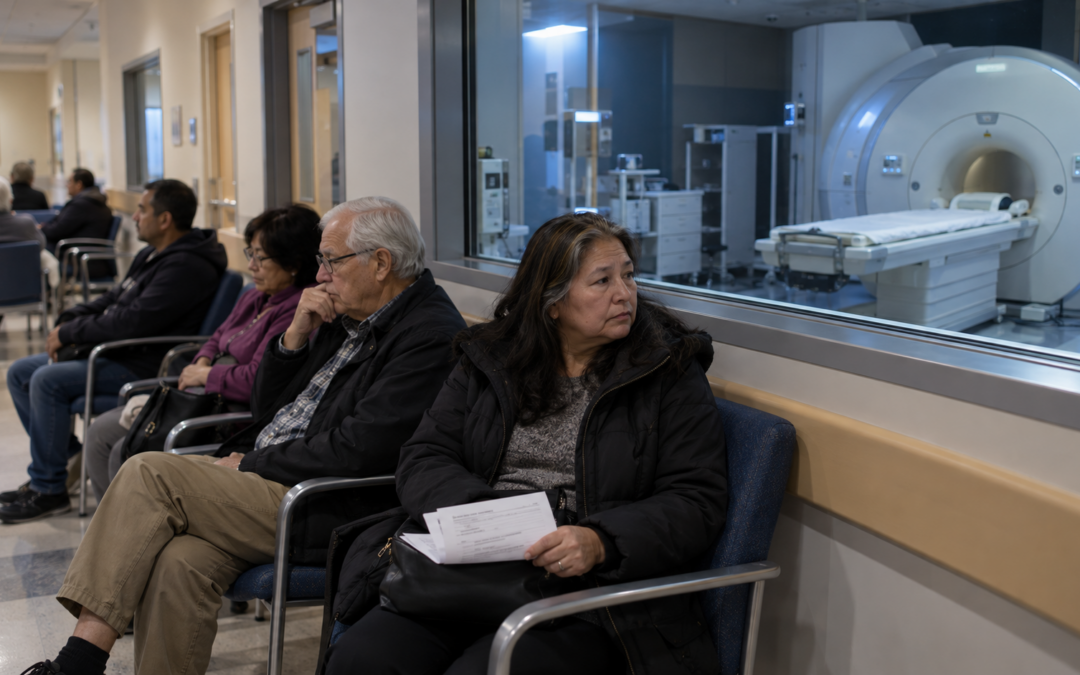
Recent research by the Ontario Health Coalition finds that Thunder Bay Regional Health Sciences Centre has three MRI machines, all of which are closed overnight on weekdays. One is closed on weekends. The other two close at 3:30 p.m. on weekends.
The Thunder Bay hospital has 13 functioning operating rooms, two of which are dedicated for C-sections and used as needed. Of the 11 other ORs, only one runs past 5 p.m. on weekdays and closes at 11:30 p.m. All the ORs are closed on weekends, except for emergencies.
“The CCPA’s research shows that privatization is driven by ideology rather than by evidence. We know that private delivery of hospital surgeries and diagnostics is more expensive, skews access to the wealthy and robs staff from the public system,” says Michael Hurley, president of the Ontario Council of Hospital Unions, the hospital division of CUPE (OCHU-CUPE).
“Funding for the private surgical and diagnostic clinics should be cancelled in the interest of efficiency and equality, and the government should ensure the efficient use of our existing public hospital infrastructure.”
For more information, contact:
Zee Noorsumar, CUPE Communications
znoorsumar@cupe.ca
647-995-9859

